And we are back for episode two of
season 16! It's called Sicarius, which is either a reference to the
Latin word for Assassin, or a kind of spider! Thanks, Google!
Things start in a hospital type
setting, where a killer has a guy named 'Josh', according to the
subtitles, lying on a gurney. Weird that he has a name – is he not
getting killed during this scene? Anyhoo, the killer – who is
wearing a black tank top, abandoning the whole 'doctor' vibe, the
Todd notwithstanding – flips Josh over and cuts off his shirt with
a pair of clothing shears. He's got a whole tray full of recently
sterilized instruments ready to go, in fact! At least, I hope they're
sterilized, it's not like he's wearing gloves or anything, so who
knows?
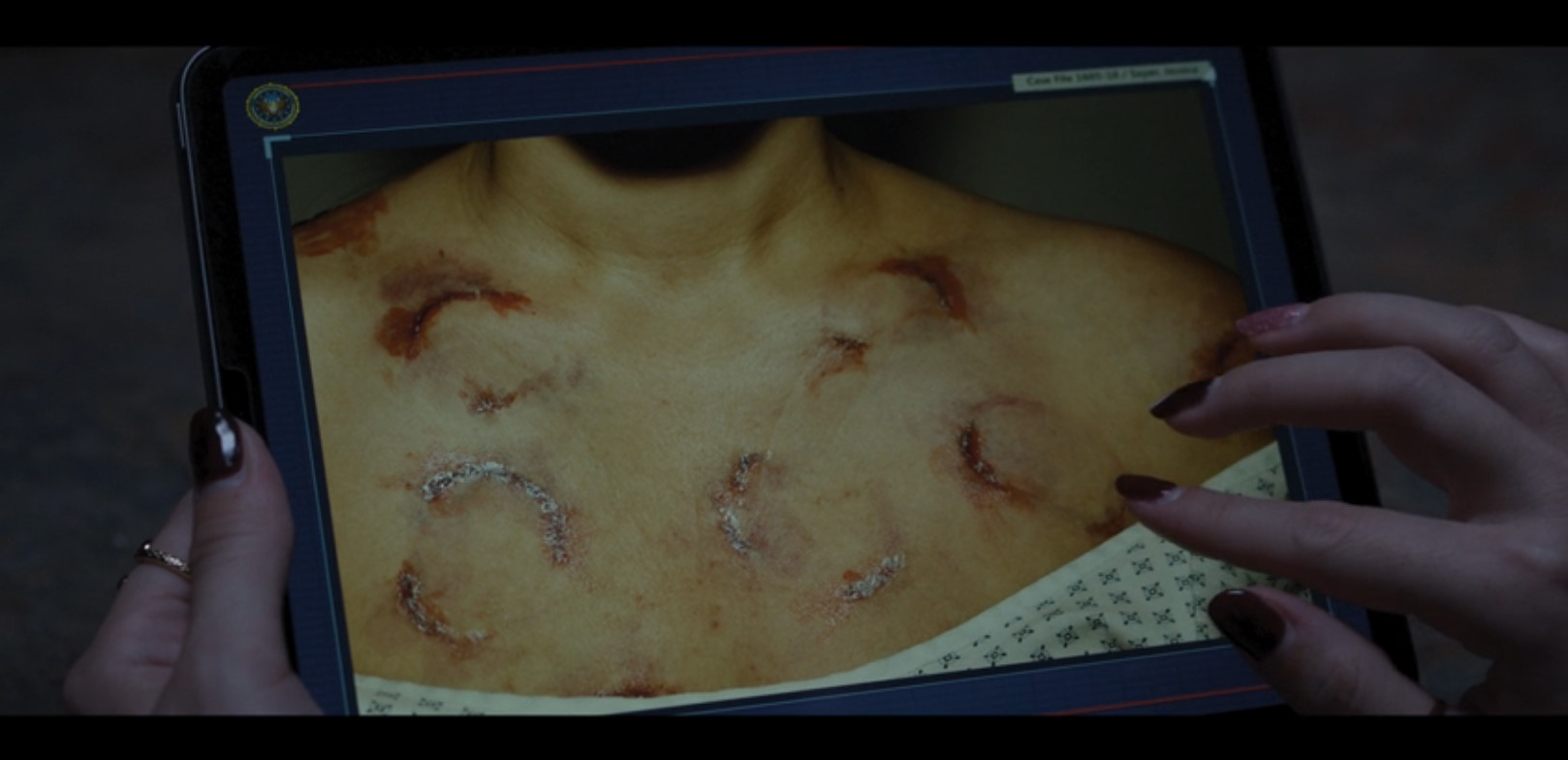
The killer puts a cameraphone down in
front of Josh's face to record his reactions and the experience –
and we see that he's sliced open Josh's back, revealing that his
spine has been revealed by cutting the skin and flesh back. The
killer tells Josh that he has a choice to make – presumably it's
'die or live paralyzed from the neck down', but that's just a guess.
Continuing the trend of showing us how
team members start their day, we start with Penelope's morning –
which is a sharp contrast to watching Joe stumbling around, trying to
shake off a hangover. Penelope starts with a workout, makes herself a
breakfast smoothie, and then tries to decide which glasses she wants
to wear today. She picks one that's perfect for her outfit, and she's
good to go! Weirdly, I'd always thought she started with the glasses
and built the outfit around them. Who knew?
She then gets on a skype call with some
people who work at her social networking site SOAR – MM is not one
of them, but that doesn't mean my theory that he's involved is wrong
with it just yet!
Then it's over to JJ, who's forgotten
that she and Jr. had a date night planned! And instead of letting
things fester, Jr. reminds her that she needs to put in work on their
relationship. Because he's an adult, and that's why we love him.
Also, he's still working as a cop, and they just got back from
Louisiana – that was not a long assignment for her!
At the office Joe stumbles in,
obviously hung over once more – it seems that his revelation that
he needs help last week hasn't exactly borne fruit just yet. In a
nice touch, the case they're working on was actually mentioned last
week, when JJ talked about a body with a severed spinal column being
dumped at a rest stop! I'd forgotten that until she mentioned the
dump site here, which means I'm going to have to start upping my game
– it seems that Criminal Minds is now interested in setups and
payoffs in the week to week episodes, not just relating to the
overall plot!
Although the spinecutter will probably
also be related to the overall plot.
Luke points out how weird it is that
the victims are good looking men in their mid-30s, which isn't a
common victimology. Joe says that it's more frequently the profile of
the killers – which I'm choosing to interpret as a hilarious
in-joke, because almost no serial killers are good looking men in
their 30s in the real world, but basically all of the serial killers
on the show are.
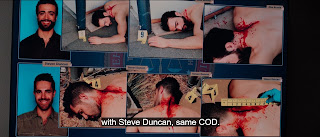
No one mentions that the two guys look
uncannily similar.
JJ mentions that the two men had
something in common – they both were on dating apps listed as
'bulls', men who will have sex with a guy's wife to satisfy a
cuckolding fantasy. JJ's jumping the gun by suggesting that they were
'targeted' because of this – although that suggests, as Joe brings
up, that it could be a man wanting revenge for his wife cheating on
him! Or it could just be a convenient way to lure a guy to a
secondary location so you can kill him. That said, in this kind of
kink community, you think that they'd have to meet at a neutral
location first to check that everything was on the up and up. Or
maybe not? I have no idea what dating apps are like.
Now things get a little weird, as JJ
says this might have a connection to last week's case, because both
unsubs switched cars in Walmart parking lots – Luke suggests that
this week's killer could be Rory's theoretical partner. Here's my
question – how do we know about the 'car switch'? One man was
dumped in a rest stop, the other in a field next to a fence
somewhere. Are they saying that the victims' cars were dumped in a
Walmart parking lot? Because if that's what you mean, say that.
More importantly, though – dumping a
car in a Walmart parking lot is not enough of a connection to suggest
a linkage between these two cases. That's just a good parking lot to
use, because it's so crowded you're guaranteed not to be noticed.
Now, if those Walmart Parking Lots had also had their security
cameras disabled by MM's serial killer starter kit device, that would
be a good connection. But again, if you mean that, say that.
This is like when Joe was all 'a man
was dumped in the woods with pieces of his skin cut off! It must be
the work of the serial killer who dates middle-aged women, cuts their
faces off, and then burns down houses to cover up his crimes!' The
crazy part is, he was wrong, it wasn't that killer – it was his
BEST FRIEND.
Next we see that the shipping container
has arrived in Quantico – Tara talks Emily through their plans to
scour it inch by inch, looking for any of the killer's DNA – and
also identifying the victims! Wait... they left the victims in the
trailer when they moved it? You know there were bones in there,
right, and there's no way to move a container across the country
without shaking it a LOT? Maybe take all of the corpses out first,
then secure and ship them separately?
Also, now that it's been moved, we can
see that there was dirt piled up around the sides of the container to
help conceal it – but again, it was by no means 'buried' – at
best you could say it was 'sunken' into the hill. Buried means the
only thing visible is the door that you use to get in. And a strict
definition would mean that door would have to be at the top.
The terrible deputy director shows up –
I guess we're going to be seeing a ton of him, so we'll use his name
'Bailey' from now on. He's not psyched about Emily taking the case –
and when she points out how absurd that is, he doesn't have a good
answer. The question is again raised – incompetent or evil?
If he's this bad at his job or corrupt,
how has there not been a joke yet about how he was appointed by
Trump?
Then it's over to Whitfield County
Georgia, where MM is showing us what it looks like when you actually
have a BURIED LAIR.
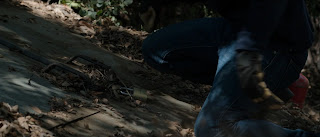
Now that's what I'm TALKING ABOUT!
BURIED FTW!
MM gets a call from someone on his
encrypted phone – yes, it's the same encryption software as RJ's
phone that he destroyed last time. Someone sends him a video from DC
– it's the snuff film from the previous night, and as predicted,
the guy's choice was quadriplegic or death, and he chose death. Which
is a real dumb move. It's 2022, dude, and we're getting closer to
nerve growth and spinal reattachment every day. Then again, he does
live in America, and may not have insurance.
MM confirms that the killer did
everything according to the 'rules' for getting away with serial
killing, then gets back to work!
So it looks like MM is running a serial
killer fraternity, where he teaches dudes to be serial killers, and
then they send him snuff films of their crimes to show off. Which is
why RJ from last week had body cam footage of the parents' murders,
even though that's obviously not something he was into.
Then we get a look at MM's bunker-

Which bears a striking similarity to
2005's guy's setup, right down to the body shelves. Did he set up
that guy's bunker when he was like 20 years old, or was that guy the
original killer that inspired MM? Did he try to kill MM, and MM wound
up recruiting him?
JJ, Luke, and Joe go over the case –
there's no overlap between the women that the men had sex with, so
it's not likely that it's an angry husband looking for direct
revenge, but they're going to investigate one of the women anyway,
because they have no other leads – the woman in question? A real
estate agent who's married to a DC city councilor!
Penelope has something mysterious going
on! She gets an anonymous message saying that they know how SOAR was
compromised, and send a block of code to be Penelope's 'REVENGE'.
This is the first we're hearing about any of this. The only person we
know of who compromised SOAR was Penelope herself, last week when she
let the FBI read members' private emails.
Hey, where is SOAR's money coming from?
Are the teens paying for it? Penelope's ethical stand suggests she's
not harvesting marketing information from them. Is MM putting up the
cash, like I suggested last time?
Penelope scans the code, and it turns
out to be GPS coordinates – two sets! The first: 38.9847, -77.0947
is a women's clothing store in Bethesda, MD, the second: 39.1456,
-76.4908, is the backyard of 7732 Bowen Rd, Pasadena, MD. I hope the
show got everyone's permission to use their addresses!
Nope! Penelope searches for them, and
it turns out that one is supposedly the address in Alexandria,
Virginia where the parents were murdered last week, and the other is
the hotel where that lady who's married to the city counsellor had
sex with their latest victim!
One question, though – why do their
faces turn up when she searches that address?
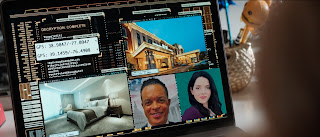
The reason I ask is – I get why RJ's
photo and the newspaper article about the killings shows up when you
put in the first address – it was heavily covered in the news. But
the only people who've connected the husband and wife to that hotel
are the FBI – it's not a public story yet, so why do their faces
come up when Penelope searches the hotel's address?
I'm sure the answer is 'they wanted the
audience to know that this was related immediately', but the
implication is that Penelope is searching the FBI's database for
anything connected to those GPS co-ordinates, which is hugely
illegal. Also, it's a nice hotel in DC – I can't imagine that this
is the only news that would come up that was related to it.
The team interviews the husband and
wife – he wanted her to cheat and send videos because it arouses
him! But last night the killer sent him a video of the murder
instead! And they didn't go to the cops, because they didn't want to
screw up the guy's political career. Can't trust politicians, people.
The politician tries to withhold the video because it will damage his
career, but JJ points out that he's covering up for a serial killer,
which is a worse thing to show up in the news than you enjoy your
wife cheating on you.
Then it's over to Emily and Tara, who
find out from Bailey that the cost of moving the shipping container
is coming out of the BAU's budget, which they're shocked and offended
by. Um... why? The BAU demanded the case, and the BAU ordered it
would be moved – where did they think the hours and money was going
to come from? Nonetheless, they think something is up with Bailey
persecuting their unit, so Emily asks Tara to call her friend at the
Justice Department and find out what's going on with him!
We drop by the container, which proves
to have zero of the offenders' DNA in it – apparently he bleached
everything, all the time. In one interesting note, he never killed
people the same way twice – it's almost as if he was experimenting
with every way you could kill a person to find the best one!
Including pouring Sicarius spiders down someone's throat! So the
title WAS about the spider! Neat!
So, I was wondering if there was a
third victim, because I didn't get a clear look at the guy who got
killed at the start, and while the characters call the corpse Steve,
the subtitles call him Josh. So hopefully my confusion makes sense.
They finally get a link to RJ and the container when the video shows
the starter kit on the guy's shelf!
This is a problem the show has – this
should have been the reveal that there's a connection. It's a perfect
moment in the show for this to happen. We're a third of the way
through the story, the characters are all working on different cases,
and then BOOM – they find a clue that forces them all to come
together as they realize that they're working on the same case! The
problem is that the producers seem to be afraid to show the
characters being surprised by anything. It's like they always want
them to know what's going on, and that just kills drama. There was no
reason for them – or us - to assume that this spinal slayer was
connected to a guy who kidnapped a teen last week, so it would have a
nice reveal for us when we see MM getting the video, and for them
when they see the starter kit. But we get robbed of that reveal by
having the characters just announce there's a connection based on no
evidence – it's as if they think that because the audience knows
about the connection, they're going to be annoyed at the characters
for not already knowing everything that they know.
When, you know, that's the heart of
good drama – what's a scarier situation – having a character walk
down a hallway and then have a guy with a knife jump out and make a
loud sound, or having a guy with a knife standing behind a doorway,
and we watch as the person slowly walks down the hallway towards
them?
Alright, enough structural criticism,
let's move on to Joe's assumption that the pandemic created the
network of killers, because they were frustrated that they couldn't
go out and hunt! Okay, again, there weren't actually any lockdowns
for more than a couple of weeks, and none that really would have
impacted serial killers, but let's give them this one, before
addressing the bigger issue... how? That's the real question – how
did MM let potential serial killers know that he was organizing a web
of murderers with him at the center?
Get it? That's what the title of
the episode means. Also the literal spiders.
There's a genuinely chilling scene of
MM going over all of the photos his proteges are sending him, and
there's so many of them that it seems impossible that they'll all be
caught by the end of the season. Just so long as we don't end up with
an ending like the CSI trilogy, where they spent three episodes
building up a human trafficking cartel so huge and powerful that
entire governments trembled in fear of it – and then they arrested
a single pimp (played by Morgan Sheppard!) who coincidentally knew
the names of and had evidence on every single member of the cartel,
allowing the whole thing to be taken down off camera over the course
of like two text messages.
How am I still angry about that
terrible set of episodes?
Gotta say, though, MM doesn't seem like
he's putting together a super-professional organization here. He's
supposed to be training people to get away with crimes, but the two
cases we know about so far are an emotional cripple who immediately
abandoned the frat and killed himself, and a dude who sends snuff
films to friends of his victims that show off his kill room.
It's worth noting that the protege
scene is essentially a carbon copy of the 'bidding' scene from Season
10, episode 1, where we're introduced to the serial killer victim
procurement ring – which turned out to just be three people in a
van?
I'm super-happy that they're actually
going through with that story this time, and doing it right!
At the office, Joe and Emily talk about
what might motivate the person making and distributing the kits, who
they assume is the guy from the container – given the show's
established reticence with letting the characters know less than the
audience, is this the rare instance where the characters are saying
something incorrect, or does MM have a boss, the killer from the
teaser in the first episode?
Tara then arrives with her friend from
the Justice Department. Apparently Bailey is best known for cutting
staff and saving money, then blaming everyone else when things go
wrong. So a pretty generic corporate goon. He thinks that this is his
fast-track to becoming the attorney general! Which seems like aiming
low. That's a political position that lasts, at most, eight years,
and then you can't really get another job afterwards outside of
joining a prestigious law firm or something along those lines. Now
Director of the FBI – that's a sweet job. You have to do
surprisingly little, and you get to blame the AG for everything that
goes wrong!
Tara's friend agrees to ask around in
the hopes of finding out what Bailey's specific problem with the BSU
is – they generate a lot of good PR for the Bureau, so why does he
specifically have it in for them?
Oh, and Tara is dating the lady from
Justice. Who I guess doesn't mind being in a relationship with a
psychopath?
Then we shift over to MM on his Johnny
Murderseed expedition, headed into Tennessee! He gets a call from
the spine slayer, who wants permission to continue killing – but MM
tells him to hold off until he's sorted something out. MM says that
someone took something of his, and he has to make sure that doesn't
happen again. Who could that have been? Was RJ using a stolen case?
Is this a computer thing? Also, MM's frustration at dealing with the
spine slayer's neediness is wonderful. You can tell that while he's
loving all the snuff films, he's hugely regretting having to spend
all of his time managing emotionally unstable people.
Oh, and I should have mentioned – in
a cute note, the spine slayer's kill room is decorated like it's
supposed to be a chiropractor's office, which is a really nice touch.
MM buys a bunch of duct tape and
wiring, then starts chatting with the cashier, a girl named Tawny.
She has enough lines that we'll almost certainly be seeing him come
after her later! Maybe in this episode? He refers to working in
'network security', and with the breach into SOAR just having been
mentioned earlier this episode, the plotlines are converging more
quickly. Oh, and Tawny has a German Shepherd named 'Moose', who she
says is too friendly to be a useful security system. Why did you say
that to the serial killer, Tawny?
The team talks about the possibility
that MM is a computer expert on Garcia's level, because he was able
to get the city councilor's phone number, and he knew where and when
the women were meeting their lovers. Except... did he? We've seen
zero evidence that the killer stalked them at their rendezvous', and
we still don't know how and when he abducted his victims. And it's
not that hard to get someone's cell phone number.
They adapt their theory about the spine
slayer a little – while talking nonsense about 'alpha' and 'beta'
males just to prove they know extremely little about psychology. They
point out that since the men often send porn to the husbands as part
of the domination kink, the killer's sending the video to the
councilor's phone could be seen as an act of domination – does he
see himself as a 'bull' as well? They'll have to go to the websites
and start profiling the victims' contemporaries!
Penelope then calls Joe and he rushes
over to get the data – she explains that there's 13 more encrypted
sets of coordinates in there, which suggests 13 more victims,
possibly unidentified ones! Joe confusingly says that this must be
partially about Garcia – which isn't the confusing part, the
confusing part is that he says that 'they' have pulled her in twice.
Um... it was you guys that pulled her in the last time. But her
getting sent the files the moment the team learned about MM's web of
killers is definitely too suspicious to be coincidental.
They don't address the big unanswered
question, though – if that's the case, how did the web KNOW that
the team had identified their network of serial killers? It hasn't
been reported in the press – so only people in the BSU and their
direct supervisors know what they're working on...
Penelope confronts Joe about his need
for therapy – and they talk about Crystal's diagnosis, so maybe it
was cancer? He's resistant to getting therapy, because all of these
damaged fools are, but Garcia talks about how much it's helped her,
and honestly delves into how much psychic damage is caused by the
work they do!
Fantastic scene, no notes.
Now the spine slayer breaks MM's rules
and kidnaps a woman he lured to a parking lot! The team gives us some
info in the next scene that's just baffling - we're told that he
dumped her car in a Costco parking lot... but why would he do that?
He was already in a secluded parking lot with her. Why not just put
her in his car and drive off? Why drive her car all the way to a
costco, transfer an unconscious person from one car to another in a
super-public place, and then leave the car there? Also, how is he
getting to the abduction sites? Does he park his car in a box store
parking lot and take a cab to the place he's going to grab someone? A
bus? That's just asking to be spotted and remembered. You're adding
extra steps to an abduction and gaining nothing by doing so. It's not
like you're disguising the abduction site – there are text messages
on the woman's phone, telling her where to go.
Also, are we supposed to believe
that he was transferring the unconscious men from car to car in
Walmart parking lots as well? That's INSANE.
Especially when we learn their next
theory – the drug he's using as a paralytic is employed, in smaller
doses, to treat pain from back injuries! What if the killer is
spine-obsessed because he had a spinal injury, and lugging all of
these huge men around is messing up his back, so now he had to grab a
much lighter woman instead? Joe points out that back injuries can
cause erectile dysfunction – and if the spine slayer defined
himself only be the sex he was having, he could now be filled with
rage if he can't perform! He suggests they bring in the woman's
husband and describe who the killer might be – he's sure they must
know him somehow!
The husband immediately identifies
their guy – a 'bull' who recently had a motorcycle accident and
couldn't work any more!
Then it's over to Garcia, who's
meditating, just like she told Joe she'd recently gotten into! She
gets a request for security help on her work laptop, and doesn't want
to do it, but can't help herself, because, in a way, she's just as
obsessed as the rest of them.
She picks it up and opens a chat with
the guy who sent the coordinates. She said that she gave them to the
FBI, and the voice is annoyed, saying that she was the only one who
could help, but now people are going to die because she went to the
authorities.
Um... dude? If you don't want her to go
to the authorities, tell her that. If the stakes are life and death,
TELL HER THAT. This is on you, pal.
Sadly, Penelope doesn't say any of that
to the guy, she just looks worried. Which I get.
Oh, and the killer has brought the
latest victim to his office. Will the team save her in time? Usually
they do, but this is on streaming now, so who knows?
Penelope goes into the office and we
get a cute little montage of her unlocking the other 13 locations!
Then they cut to a diagram of the shipping container:
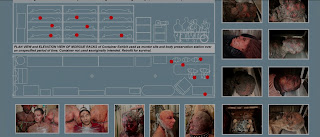
Which is kind of hilarious in a couple
of ways:
1 – We were told that there were 16
bodies, not counting the box of bones, but there's clearly 17.
2 – there's a typo: “asoriginally”
3 – Why would you note that it wasn't
used as originally intended? It's a container for storing things.
That's what it's doing.
4 – They say it's 'retrofit for
survival', which I guess is a reference to it being weatherproofed so
that it could survive years in a field, but that's not super clear.
Things then get a little funny when
Tara hears a beeping inside the trailer – the starter kit proves to
have a tracking device set in it under the foam! We were told that
they scoured every millimeter of the trailer for DNA... and they
didn't bother checking under the foam in a box? Or even removing the
murder supplies from said box? Come on, team, get your act together.
It seems that the codes Garcia put in
are the transponders on the starter kits that people use to find and
dig them up! The guy on the internet could have been clearer – the
first two codes were, I guess, proof that he knew about the murders,
and the rest were the locations of cases? So is that what was stolen
from MM? The transponder codes for all of the cases?
We get a look at MM's project –
setting a bomb to blow up his lair and destroy all of the evidence
inside. Then he gets an alert on the Spine Slayer – real name
Robert Harris – and he's obviously troubled that the guy wasn't
following his directions.
He phones up Robert and tells him that
he got sloppy – not killing at a secondary location or pausing when
told to. I'm not sure how he knows Bob isn't at a secondary location
– he says that it's because of the beeping, but that's just the
transponder in the kit being active, there's no reason he couldn't
have the kit at a secondary location. In fact, he should – keeping
a serial killer starter kit in your own house is a great way to get
caught. MM tells Bob that he knows what he has to do, but Bob says he
can't do it – MM says he'll walk him through the process.
So is part of the deal with joining the
frat that you have to kill yourself if compromised? It seems so,
because the team rushes in and finds Bob on the ground with his
throat slashed. And his victim, Michelle, is still alive? That's
weird. Now there's a witness to MM phoning Bob and telling him to
kill himself. Super-sloppy there, MM.
Back at the office, they report that
Bob killed himself, and says that there was nothing in his profile
that made it seem like he was suicidal – just like RJ.
Point of order – RJ's suicide was
absolutely predictable. He was an abused kid living in a fantasy
world, full of guilt and self-hatred, faced with the realization that
the girl he loved thought he was a monster. Also, he killed himself
BEFORE he knew the cops were on to him. You suck at profiling, guys.
They do correctly guess that it's part
of the frat deal that you kill yourself rather than getting caught –
but Joe's not worried, because they know the location of 12 other
cases! Penelope then comes out and tells Joe that 'this is bad'.
Before we can find out what she means
by that, we see Tawny and her pupper sitting on a couch at home,
while MM lurks in the bushes outside!
Turns out the 'this is bad' is the
transponders going offline. I don't know why they're surprised that
this is happening – you turned on a signal that made all of the
cases loudly beep, did you think the killers were just going to let
that keep happening? Spoiler alert: eventually people just take the
batteries out of the smoke detector.
Penelope asks if she just made things
worse, which is silly – now you have a lead – 12 cities with
killers in them. You didn't have that this morning. Interestingly,
the cases he's been hiding in Georgia and Tennessee are not on the
map:
So did he stop using the transponders
at some point, or did the deep throat-style character just not have
all of the info?
Now that she sees how bad the situation
is, Penelope realizes she's going to have to come back to work, and
Joe doesn't have the guts to just straight out ask her. Another
beautifully written and acted scene between them!
Then Joe calls his hotel and says he'll
be checking out. Time to get serious about his life. Which is a nice
touch. Garcia finds a post-it she left for the next person to use the
office – which turns out to have been her! No idea what it says,
yet.
MM drives home to Seattle, dumps things
in his own starter kit, and we're horrified to learn that one of
those things is the collar from Moose, Tawny's beloved dog! There
wasn't a transponder signal from Seattle, so it's safe to say he
didn't mark his own case, because why would he?
Then we meet MM's wife and find out
he's got daughters! So yes, this is inspired by the Israel Keys story
that was mentioned earlier in the episode. He was a serial killer who
lived in Alaska and only killed people after flying to the lower 48
and driving far enough that there was no possible connection between
his flight and the place he robbed or people he killed. It's been
hugely adapted, of course, but the idea of a guy having a basically
normal home life and then heading out of state to kill is cribbed
from that real-life true crime tale.
We get another scene with JJ and Jr,
where she makes an effort to put their relationship first! Yay! And
they're directly tying in the relationship issues with both the case
of the week and what the killer's got going on in his own life! This
is great work by the episode!
Then we find out what's going on –
Bailey wants to shut down the BAU and reorganize it to focus on
domestic terrorism! Given the right-wing's plan for a violent fascist
takeover of America, this seems like a really good thing, actually,
and I'm not sure if I'm on the team's side vis a vis chasing serial
killers. Like, obviously they're a problem, but Trump being made
god-emperor and all of congress being publicly executed seems like
the bigger issue, don't you think?
Oh, and Penelope's back working at the
FBI! Yay!
How useful was profiling at solving the
crime:
0/10
The killer kidnapped someone he knew,
and brought her back to his house. Not exactly a brain-teaser. Yes,
they were able to describe the killer's likely injuries to the
husband to help him figure out who the killer was – but even if
they'd just said to the guy 'do you know anyone from the cuckolding
community who might have a grudge against you and other bulls?', the
husband would have immediately said 'our old bull was injured in a
motorcycle accident and had to stop working'. So they would have
gotten to him either way.
Wait, but if they used profiling, why
did it get a zero? Simple: the guy killed himself based on the source
sending Garcia the tracking information, and him getting a call from
MM. If the team hadn't ever talked to the husband, here's what would
have happened – Bob would have killed himself, the drugs would have
worn off, and the wife would have called the cops to come and get
her.
Two zeros in a row, Criminal Minds –
that's weird... right?



.jpg)
.jpg)
.jpg)
.jpg)
.jpg)


